
Combining all the features of flexible circuits with rigid circuit boards that fully leverage high-density interconnect (HDI) technology represents a major technological breakthrough of our time.
This design successfully avoids the need for board-to-board stacking connectors or typical flexible circuits.
Anyone who has attempted to mate a flexible circuit with a stacking connector knows that this is a bottleneck in the entire process—this “blind mating” operation is extremely demanding on manual dexterity, and even the slightest misalignment can result in connector damage.
The rigid-flex design combines the strengths of both approaches while also incorporating their limitations.
First, if a team adopts this approach, it indicates that they place great importance on all possible integrations.
Although both technologies are highly regarded in their own right, the rigid circuit board sector is currently larger and enjoys greater recognition.
Independent Applications of Flexible Circuits
Flexible printed circuits (FPCs) require more than just a change in materials; they must be designed to be more robust than their rigid counterparts.
Additional tolerances must be built into the design.
One key reason for this is the stacking of various types of materials during the manufacturing process.
In most cases, flexible boards also include rigid sections for mounting connectors.
Furthermore, these reinforced areas can be extended to accommodate components such as electrostatic discharge (ESD) protection devices, light-emitting diodes (LEDs), or microphones, offering a high degree of flexibility.

Zero Insertion Force (ZIF) connectors, which can be printed directly onto flexible circuit boards, are a prime example.
With this method, a reinforcing tab is located at the end of the flexible board to support the pins.
The tab is inserted into the mating connector, and then a lever on the connector is pressed to lock the flexible board’s tab into place.
Whether using a fully flexible board or a rigid-flex board, assembly with ZIF connectors is simpler than using stacked connectors.
Examples of Rigid-Flex Applications
Flexible circuit boards have a wide range of applications.
For instance, in wearable technology designs, attaching a stiffener to the center of a flexible board creates circular islands.
Components cluster like small colonies atop these stiffener islands, while the circuitry runs around them.
Rigid sections are integrated into augmented reality headsets and positioned around the ears and other locations.
Applications such as eye tracking require more complex design solutions.
Regardless of the substrate material chosen, a 12-layer board cannot be made entirely flexible.
Semi-flexible boards can be considered; meanwhile, the advantage of rigid-flex boards lies in their ability to achieve complex routing with up to a dozen layers in specific local areas.
Additionally, a flex core extends from the rigid board and is specifically designed to handle a particular set of signal lines.
A common configuration involves embedding three flexible layers within an 8-layer or 10-layer board.
Odd-layer designs are also not uncommon; for instance, to achieve maximum flexibility, the stackup can be constructed starting with a single-sided flexible layer.
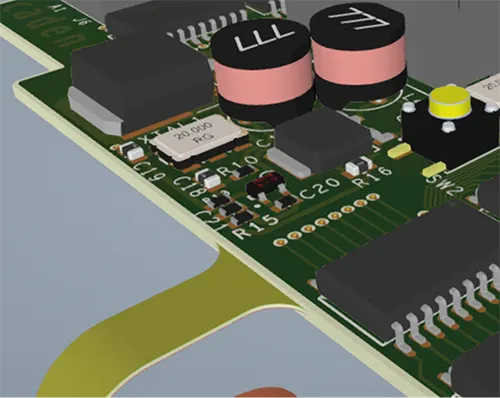
The Advantages of Combining Rigidity and Flexibility
The use of a polyimide core stack enables the rigid sections to support dual-sided component mounting.
Typically, the design requirement for such products is “the smaller, the better”; since this cutting-edge solution has been chosen, it indicates that the design challenges we face must be highly complex.
Consequently, ball grid array (BGA) packaging and various related micro-components come into play.
Small BGAs typically serve as auxiliary circuits for larger BGAs and may be distributed across other rigid board areas at various locations within the rigid-flex board.
Continuing with the augmented reality (AR) theme, one use case involves flexible antenna extensions, where the antenna’s position and orientation are integral to the product’s overall profile.
The radio chip is located on the rigid-flex circuit board, so the remote antenna functions as a flexible extension.
Such special cases may also require dedicated electromagnetic interference (EMI) shielding.
This EMI suppression material must be soldered to a ground plane specifically laid out for this purpose.
Since the EMI film is applied last, a series of small slots must be cut into the cover film to expose these areas.
During design, these details must be fully considered and incorporated into the additional physical layers.
Pursuing Coexistence
Coexistence is always the primary consideration, especially in the early stages of design.
Once a viable solution is identified, you can try removing safety measures to see if the design still meets standards.
This is what we call lean design—reducing the number of components through iteration.
In practice, however, the early design phase may actually require additional filters or other improvements, leading to an increase in the number of components.
If you are familiar with flexible PCB manufacturing, you know that the transition from rigid to flexible areas is one of the key challenges.
The same applies when exiting the rigid area.
Polyimide extends through the entire rigid area and branches out into the flexible section to reach the destination.
These destinations can be entirely new circuit boards with a structure identical to the main rigid board, or they can utilize common solutions such as stiffeners and connectors.

We cannot have a 4-layer board in one section and a 10-layer board in another within the same design.
Since all sections are laminated simultaneously, like a “layer cake,” the lamination process for all multi-layer rigid sections must be completely consistent; only at the lead-out end of the flexible board can we apply various conventional flexible board geometries.
Although it is customary to place a connector at that end, it can actually be any combination of components that can be implemented on a single-sided flexible printed circuit assembly (FPCA).
Routing Controlled-Impedance Traces on Rigid-Flex Printed Circuit Boards (PCBs)
This scenario is common: we often need to extend differential pairs from a rigid section into a flexible section.
Consider a 3-layer flexible PCB with a ground plane on the outer layer, where the signal traces are contained within a Faraday cage; this is a prerequisite for achieving controlled impedance.
Placing the signal at the center of the flexible stackup, within the neutral layer of the flexible stackup, reduces the stress on the signal.
In contrast, if a two-layer structure is used, the bending area would subject the traces to severe tension or compression.
We aim to maintain consistent impedance from the inside to the outside of the rigid region.
Specifically, this is achieved by continuing to lay a ground plane alongside the traces on the outer layer of the polyimide.
Beyond the controlled impedance routing area, the outer layer of the flexible board is more likely to use a solid ground plane; while this sacrifices some flexibility, it provides a more stable upper and lower reference plane for the transmission lines.
If you wish to reduce issues caused by connector-specific failure modes and assembly challenges, a rigid-flex board may be a good choice.
Although it requires more time investment in both layout planning and adapting to manufacturer limitations, the assembly advantages are sufficient to offset the initial investment.
The improvement in reliability is merely a bonus; the key is to achieve the stability of rigid boards and the flexibility of flexible boards simultaneously.
Click “Read Original” at the end of the article to access the e-book *Guide to Flexible and Rigid-Flex PCB Design*, which explores the factors to consider when designing flexible and rigid-flex PCBs and helps designers understand the knowledge and techniques required to create successful products.
Conclusion
Rigid-flex PCB design represents a significant evolution in modern electronics, enabling engineers to combine the structural stability of rigid boards with the adaptability of flexible circuits in a single, highly integrated solution.
By eliminating the need for complex connectors and reducing assembly challenges, this approach not only improves reliability but also streamlines manufacturing and enhances overall product performance.
However, rigid-flex PCB design is not without its complexities.
From managing layer stackups and material transitions to ensuring controlled impedance and mechanical durability, every stage demands careful planning and close collaboration with manufacturers.
Success lies in balancing flexibility with rigidity while maintaining electrical integrity and manufacturability.
As electronic devices continue to shrink in size while increasing in functionality, rigid-flex PCB design will play an increasingly critical role.
For designers seeking compact, high-performance, and reliable solutions, investing in a well-optimized rigid-flex PCB design is not just an option—it is a strategic advantage.