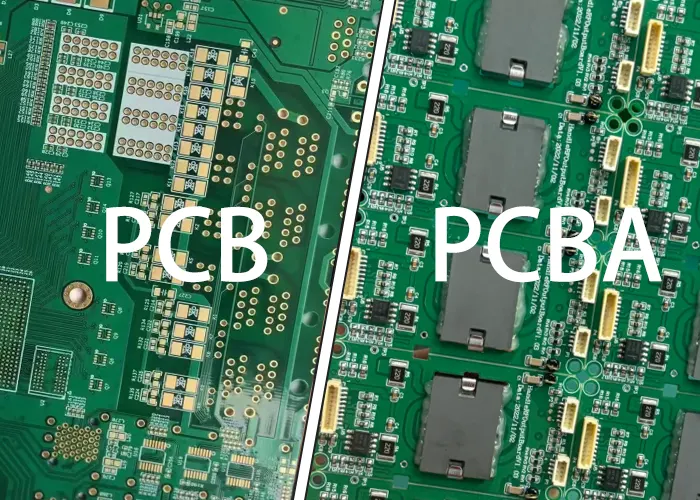
To understand electronic manufacturing, it is essential to recognize that PCB and PCBA are not competing technologies. Rather, they represent sequential stages of the same manufacturing process.
PCB vs PCBA
A PCB serves as the physical foundation of an electronic device. A PCBA transforms that foundation into a functioning electronic system.
What Is a PCB?
A Printed Circuit Board (PCB) is a fabricated board consisting of conductive copper pathways laminated onto an insulating substrate material. It provides both mechanical support and electrical connectivity for electronic components.
Without a PCB, electronic devices would require extensive point-to-point wiring, resulting in larger products, lower reliability, and significantly higher manufacturing costs.
For this reason, a PCB is often described as the “electronic skeleton” of a device. It provides the structural framework upon which the entire electronic system is built.
Modern PCBs typically consist of several key elements:
| PCB Element | Function |
|---|---|
| Substrate | Provides mechanical strength and insulation |
| Copper Layers | Carry electrical signals and power |
| Vias | Connect conductive layers together |
| Solder Mask | Protects copper traces and prevents short circuits |
| Silkscreen | Identifies components and assembly markings |
Although a PCB contains all necessary electrical pathways, it cannot perform any useful function on its own because no active or passive electronic components have been installed.
What Is a PCBA?
A Printed Circuit Board Assembly (PCBA) is a PCB that has been populated with electronic components and assembled into a functional circuit.
The assembly process involves mounting components such as:
Integrated circuits (ICs)
Resistors
Capacitors
Connectors
Sensors
Microcontrollers
Power management devices
Once these components are soldered onto the board and tested, the result is a complete electronic assembly capable of performing its intended function.
If the PCB is the skeleton, then the PCBA can be viewed as the complete body. The installed components provide intelligence, communication capability, power regulation, sensing functions, and signal processing.
A smartphone motherboard, automotive control module, medical monitoring system, or industrial automation controller are all examples of PCBAs rather than simple PCBs.
A Simple Analogy: Empty House vs Fully Furnished Home
One of the easiest ways to understand the distinction is through a housing analogy.
Imagine a newly constructed house. The walls, foundation, electrical wiring, and plumbing have been completed. Structurally, the house exists, but it is not yet ready for occupancy.
This is equivalent to a PCB.
Now imagine the same house after furniture, appliances, lighting, internet equipment, and décor have been installed.
The house is now fully functional and ready to serve its intended purpose.
This is equivalent to a PCBA.
The PCB provides the infrastructure. The PCBA delivers functionality.
PCB vs PCBA Comparison
| Aspect | PCB | PCBA |
|---|---|---|
| Definition | Bare printed circuit board | Fully assembled circuit board |
| Functionality | Non-functional | Functional electronic assembly |
| Components Installed | No | Yes |
| Manufacturing Stage | Fabrication | Assembly |
| Complexity | Lower | Higher |
| Cost | Lower | Higher |
| Testing Requirements | Electrical continuity testing | Functional and performance testing |
| End Use | Intermediate manufacturing product | Final electronic subsystem |
Understanding this distinction is critical because most electronic products never use bare PCBs directly. The end product almost always incorporates PCBAs that have undergone assembly and testing.
Journey from Concept to Functional Electronics
Every electronic product follows a transformation process that begins as a design concept and ends as a fully functional PCBA.
Understanding this journey helps explain why PCB fabrication and PCB assembly are separate manufacturing disciplines.
Stage 1: Circuit Design
The process begins with electronic design engineers creating a schematic diagram that defines how components interact electrically.
Using Electronic Design Automation (EDA) software such as Altium Designer, KiCad, or Cadence, engineers convert the schematic into a physical PCB layout.
At this stage, designers determine:
Component placement
Signal routing
Layer stackup
Power distribution
Thermal management
Electromagnetic compatibility (EMC)
Design decisions made during this phase directly influence manufacturing cost, reliability, and product performance.
Stage 2: PCB Fabrication
Once the design is finalized, manufacturing files are generated and sent to a PCB fabrication facility.
The fabrication process transforms digital design files into physical circuit boards through a series of precision manufacturing operations.
These operations typically include:
Copper imaging
Chemical etching
Layer lamination
CNC drilling
Via metallization
Solder mask application
Surface finishing
Electrical testing
The result is a bare PCB containing all required electrical pathways but no installed components.
Stage 3: PCB Assembly
The fabricated PCB then moves to the assembly stage.
This process involves mounting and soldering electronic components according to the Bill of Materials (BOM).
Modern assembly facilities typically use highly automated Surface Mount Technology (SMT) equipment capable of placing tens of thousands of components per hour with micron-level accuracy.
The assembly process generally includes:
Solder paste printing
Automated component placement
Reflow soldering
Through-hole assembly
Automated optical inspection (AOI)
At this point, the PCB becomes a PCBA.
Stage 4: Testing and Validation
A PCBA must be verified before it can be integrated into a final product.
Testing procedures may include:
In-Circuit Testing (ICT)
Flying Probe Testing
Functional Testing (FCT)
Boundary Scan Testing
Environmental Stress Testing
Industry studies from organizations such as the IPC (Association Connecting Electronics Industries) indicate that comprehensive testing significantly improves field reliability and reduces warranty failures.
The final output is a fully functional electronic assembly ready for installation into a finished product.
Electronics Manufacturing Workflow
Concept → Circuit Design → PCB Layout → PCB Fabrication → PCB Assembly → Testing & Validation → Finished Electronic Product
This workflow highlights a crucial reality: every PCBA begins as a PCB, but not every PCB becomes a finished product until assembly and testing have been completed.
Inside a PCB: What Makes a Bare Board So Important?
Although PCBAs receive most of the attention because they contain active electronics, the quality of the underlying PCB largely determines the performance, reliability, and manufacturability of the final product.
A poorly designed PCB can create signal integrity issues, thermal failures, assembly difficulties, and long-term reliability problems regardless of how advanced the installed components may be.
Core PCB Structure
Modern PCBs are sophisticated engineered structures composed of multiple materials and conductive layers.
The substrate serves as the mechanical backbone of the board, providing insulation between conductive layers while maintaining structural rigidity.
Copper layers form the electrical highways that distribute signals and power throughout the circuit.
Vias create vertical interconnections between layers, enabling compact multilayer designs.
The solder mask protects exposed copper from oxidation and prevents accidental short circuits during assembly.
Finally, the silkscreen layer provides reference markings that assist assembly technicians and maintenance personnel.
Together, these elements create a highly reliable platform capable of supporting increasingly complex electronic systems.
Types of PCBs
PCB technology has evolved dramatically to meet the demands of modern electronics.
Single-sided PCBs remain common in low-cost consumer products where circuit complexity is limited.
Double-sided PCBs provide increased routing flexibility and are widely used in industrial equipment and consumer electronics.
Multilayer PCBs dominate advanced applications such as networking equipment, servers, smartphones, and medical devices. Modern high-performance boards frequently contain between 4 and 20 layers, while specialized aerospace systems may exceed 50 layers.
Flexible PCBs utilize polyimide substrates that allow bending and folding, making them ideal for wearable devices, cameras, and compact electronics.
Rigid-flex PCBs combine rigid and flexible sections into a single structure, reducing connectors and improving reliability.
High-Density Interconnect (HDI) PCBs represent one of the fastest-growing PCB technologies due to increasing miniaturization requirements. HDI designs employ microvias, finer traces, and higher routing density to support compact, high-performance electronics.
Why PCB Design Determines Product Success
The PCB is far more than a platform for holding components. It plays a direct role in determining product performance.
Signal integrity becomes increasingly important as operating frequencies rise into the gigahertz range. Poor routing can introduce noise, timing errors, and electromagnetic interference.
Thermal management is equally critical. Power electronics, processors, and communication devices generate significant heat. Proper PCB design helps distribute and dissipate thermal energy efficiently, preventing premature component failure.
Reliability is heavily influenced by material selection, layer construction, via design, and manufacturing quality. In automotive, aerospace, and medical applications, PCB reliability directly impacts safety and regulatory compliance.
Manufacturability also begins at the PCB design stage. Designs optimized for manufacturing reduce production costs, improve assembly yields, and shorten production cycles.
As electronic products continue becoming smaller, faster, and more complex, the PCB remains the fundamental engineering platform upon which all modern electronic innovation is built.
Inside a PCBA: Where Electronics Come Alive
While a PCB provides the structural and electrical foundation of an electronic product, it is the PCBA that brings the design to life. Through the installation of electronic components and the execution of sophisticated assembly processes, a bare board is transformed into a functioning electronic system capable of sensing, processing, communicating, and controlling.
In today’s electronics industry, PCBAs power everything from smartphones and wearable devices to automotive safety systems and aerospace navigation equipment. Their performance depends not only on the quality of the underlying PCB but also on the selection, placement, and reliability of every component mounted on the board.
Components Found on a PCBA
A modern PCBA may contain dozens, hundreds, or even thousands of components depending on the complexity of the application.
Resistors are among the most common components found on a PCBA. They regulate current flow, divide voltages, and protect sensitive circuits from excessive electrical loads.
Capacitors store and release electrical energy, stabilize power supplies, filter noise, and support signal integrity. In high-speed electronic systems, capacitors play a critical role in maintaining reliable operation.
Integrated Circuits (ICs) are often considered the “brains” of the assembly. These semiconductor devices perform computational tasks, data processing, signal conversion, memory storage, and system control. Modern microprocessors and system-on-chip (SoC) devices may contain billions of transistors within a single package.
Sensors enable electronic products to interact with their environment by detecting physical parameters such as temperature, pressure, acceleration, humidity, light, or motion.
Connectors provide interfaces between the PCBA and external systems, including power supplies, displays, communication cables, batteries, and peripheral devices.
The complexity of today’s electronic products means that a single PCBA often incorporates all of these components into a highly integrated system.
Typical Functions of Common PCBA Components
| Component Type | Primary Function | Example Applications |
|---|---|---|
| Resistors | Current control and voltage division | Power regulation circuits |
| Capacitors | Energy storage and filtering | Power supplies, RF systems |
| ICs | Processing and control | Smartphones, computers |
| Sensors | Environmental monitoring | Automotive and IoT devices |
| Connectors | External interfacing | Charging ports, communication systems |
How Components Work Together
A PCBA is far more than a collection of individual components. Each component contributes to a larger system architecture designed to perform specific functions.
Signal processing is one of the most important roles of a PCBA. Electronic signals generated by sensors, communication modules, or user interfaces are transmitted through the PCB and processed by microcontrollers, processors, or specialized integrated circuits. These signals are then converted into meaningful outputs, such as displaying information, controlling motors, or transmitting data.
Power management represents another essential function. Electronic devices require stable voltage and current levels to operate reliably. Power management circuits regulate incoming power, distribute it to various subsystems, and protect components from electrical faults.
Communication capabilities have become increasingly important in modern electronics. Whether using Wi-Fi, Bluetooth, GPS, Ethernet, CAN bus, or cellular networks, PCBAs serve as the communication hub that enables devices to exchange information with users, other devices, and cloud platforms.
In advanced electronic systems, these functions operate simultaneously. For example, an automotive Advanced Driver Assistance System (ADAS) module continuously receives data from cameras and sensors, processes the information in real time, manages power consumption, and communicates with vehicle control systems—all through a single PCBA.
Why Assembly Quality Matters
Even the best PCB design can fail if assembly quality is compromised.
The electronics industry has learned through decades of field experience that manufacturing defects are among the leading causes of product failures. Common assembly issues include insufficient solder joints, component misalignment, solder bridging, contamination, and thermal damage during reflow.
According to industry reliability studies published by the IPC and electronics manufacturing organizations, solder-related defects account for a significant percentage of electronic assembly failures, particularly in harsh operating environments.
Assembly quality directly influences product reliability. Poor solder connections may initially pass inspection but fail after repeated thermal cycling, vibration exposure, or prolonged operation.
Product lifespan is also closely tied to assembly quality. High-quality PCBAs can operate reliably for decades in industrial, aerospace, and medical applications, while poorly assembled products may experience premature failures within months.
Field failures are especially costly because they occur after products have been delivered to customers. Warranty claims, recalls, production downtime, and reputational damage often far exceed the original manufacturing cost.
For this reason, leading electronics manufacturers invest heavily in automated optical inspection (AOI), X-ray inspection, in-circuit testing (ICT), and functional testing to ensure every PCBA meets stringent quality standards before shipment.
PCB vs PCBA Cost Breakdown: Where the Money Goes
One of the most common questions asked by product developers and procurement teams is why a PCBA costs significantly more than a bare PCB.
The answer lies in the additional materials, labor, equipment, testing, and quality control processes required to transform a fabricated board into a functioning electronic assembly.
Understanding the major cost drivers can help companies optimize designs, reduce manufacturing expenses, and improve profitability without sacrificing product quality.
PCB Cost Drivers
The cost of PCB fabrication is largely determined by the physical characteristics of the board.
Material selection has a substantial impact on pricing. Standard FR-4 materials remain the most economical choice for most applications, while high-frequency laminates, metal-core substrates, and specialty materials significantly increase manufacturing costs.
Layer count is another major factor. Each additional conductive layer requires extra lamination, drilling, imaging, and inspection processes.
Board size directly influences material consumption and manufacturing efficiency. Larger boards require more raw materials and occupy more production capacity.
Surface finishes such as HASL, ENIG, Immersion Silver, and OSP vary in cost and performance characteristics.
Major PCB Cost Factors
| Cost Driver | Impact on Cost |
|---|---|
| Material Type | Medium to High |
| Layer Count | High |
| Board Dimensions | Medium |
| Surface Finish | Medium |
| Drill Complexity | Medium |
| HDI Features | High |
PCBA Cost Drivers
While PCB fabrication costs are primarily driven by board construction, PCBA costs are heavily influenced by component and assembly requirements.
Components frequently represent the largest percentage of total assembly costs. In many electronic products, components account for 60% to 90% of overall PCBA expenses.
Assembly labor and machine time contribute additional costs. High-density assemblies containing hundreds or thousands of components require more placement operations, inspection procedures, and process controls.
Testing requirements further increase manufacturing expenses. Medical, automotive, aerospace, and industrial products often require extensive validation procedures to meet regulatory and reliability standards.
Yield rates also play a critical role. Lower manufacturing yields increase effective production costs because defective assemblies require rework or replacement.
Typical PCBA Cost Distribution
| Cost Element | Approximate Share |
|---|---|
| Electronic Components | 60%–90% |
| PCB Fabrication | 10%–25% |
| Assembly Process | 5%–15% |
| Testing and Inspection | 3%–10% |
Actual percentages vary depending on product complexity and production volume.
Example Cost Comparison
The relationship between PCB and PCBA costs becomes clearer when comparing different production scenarios.
Illustrative Cost Comparison
| Production Scenario | PCB Cost Per Unit | PCBA Cost Per Unit |
|---|---|---|
| Prototype (10 pcs) | $15–$50 | $80–$300 |
| Medium Volume (1,000 pcs) | $3–$15 | $20–$100 |
| Mass Production (100,000+ pcs) | <$2–$8 | $5–$50 |
These values represent industry averages and vary significantly based on design complexity, component availability, testing requirements, and geographic manufacturing location.
The table demonstrates that PCBA costs are consistently higher because they include both the fabricated PCB and all assembly-related expenses.
How to Reduce Costs Without Sacrificing Quality
Cost optimization begins during the design phase.
Design for Manufacturability (DFM) principles help simplify assembly processes and improve production yields. Standardizing component packages can reduce sourcing complexity and placement time.
Early collaboration with manufacturing partners often identifies opportunities to lower costs before production begins. PCB stack-up optimization, component consolidation, and assembly process improvements can generate significant savings.
Component lifecycle management is equally important. Selecting widely available components reduces supply chain risks and helps avoid expensive redesigns caused by obsolescence.
The most successful electronics companies focus on total lifecycle cost rather than simply pursuing the lowest initial manufacturing price.
PCB vs PCBA Applications Across Modern Industries
The importance of PCB and PCBA technologies extends across virtually every sector of the global economy.
As electronic systems become increasingly sophisticated, demand for advanced PCB fabrication and assembly solutions continues to grow.
According to industry research from organizations such as IPC and market analysts, the global PCB industry is projected to exceed hundreds of billions of dollars in value over the coming decade, driven by automotive electrification, industrial automation, artificial intelligence, and next-generation communication technologies.
Consumer Electronics
Consumer electronics remain one of the largest markets for PCBs and PCBAs.
Smartphones rely on highly complex multilayer HDI PCBAs that integrate processors, memory, cameras, wireless communication modules, and power management circuits within extremely compact footprints.
Tablets and laptops use advanced multilayer assemblies to deliver high-performance computing while maintaining thin and lightweight form factors.
Wearable devices such as smartwatches and fitness trackers increasingly utilize flexible and rigid-flex PCB technologies to accommodate compact, ergonomic designs.
Automotive Systems
Modern vehicles contain dozens or even hundreds of PCBAs.
Advanced Driver Assistance Systems (ADAS) process data from cameras, radar sensors, and LiDAR systems to improve vehicle safety.
Battery Management Systems (BMS) continuously monitor cell voltage, temperature, and charging performance in electric vehicles.
Electronic Control Units (ECUs) manage critical vehicle functions including engine performance, braking, steering, transmission control, and infotainment systems.
The rapid growth of electric vehicles is creating significant demand for high-reliability automotive PCBAs capable of operating in harsh environments.
Medical Devices
Medical electronics represent one of the most demanding application areas for PCBAs.
Patient monitoring systems depend on highly reliable assemblies to collect and process critical physiological data.
Medical imaging equipment such as CT scanners, MRI systems, and ultrasound machines utilize sophisticated PCBAs to control imaging functions and process large volumes of data.
Implantable medical devices, including pacemakers and neurostimulators, require exceptionally reliable miniature PCBAs capable of operating continuously for many years.
Strict regulatory requirements make quality and reliability essential considerations in medical electronics manufacturing.
Industrial Automation
The transition toward Industry 4.0 is accelerating demand for advanced PCBAs in manufacturing environments.
Programmable Logic Controllers (PLCs) use industrial-grade PCBAs to monitor and control production equipment.
Robotic systems rely on high-performance control boards to execute precise motion control and machine vision tasks.
Smart manufacturing systems integrate sensors, communication networks, and data analytics platforms through interconnected PCBAs that support real-time operational monitoring.
Reliability is especially important because failures can result in costly production downtime.
Aerospace and Defense
Few industries place greater demands on PCB and PCBA performance than aerospace and defense.
Navigation systems require highly reliable assemblies capable of maintaining precise operation under extreme environmental conditions.
Radar systems utilize advanced multilayer high-frequency PCB technologies to process complex electromagnetic signals.
Satellite electronics depend on radiation-resistant PCBAs engineered for long-term operation in space environments where repair is impossible.
Because failures can have mission-critical consequences, aerospace PCBAs undergo some of the most rigorous qualification and testing procedures in the electronics industry.
As technology continues to evolve, PCBs and PCBAs will remain the foundation of innovation across consumer electronics, transportation, healthcare, industrial automation, and advanced defense systems. Understanding their differences and applications is therefore essential for engineers, designers, manufacturers, and procurement professionals alike.
Conclusion:
In electronics manufacturing, confusion between PCB (Printed Circuit Board) and PCBA (Printed Circuit Board Assembly) is not a semantic issue—it is an operational and financial risk.
The distinction defines whether a company is sourcing a structural substrate or a fully functional electronic system.
Treating them as interchangeable often leads to incorrect quotations, incomplete procurement, delayed production schedules, and avoidable engineering rework.
At a technical level, a PCB is the passive infrastructure: copper traces laminated on insulating material that define electrical interconnections.
A PCBA is the result of transforming that infrastructure into a working system through component placement, soldering, and validation testing.
In industrial practice, this transformation typically represents the most value-intensive phase of electronics manufacturing, as it introduces active functionality, system intelligence, and application-specific behavior.
From a lifecycle perspective, most modern electronic products do not deploy PCBs directly.
Instead, they rely on PCBAs that integrate semiconductors, passive components, sensors, and interconnects into a validated subsystem ready for integration into final products.
Key Takeaways
| Concept | Definition | Role in Product Lifecycle |
|---|---|---|
| PCB | Bare printed circuit board with copper routing and substrate | Mechanical + electrical foundation |
| PCBA | PCB populated with electronic components and tested | Functional electronic subsystem |
This distinction is foundational because it determines how engineering teams structure sourcing, budgeting, and validation strategies.
According to the IPC (Association Connecting Electronics Industries), a large proportion of field failures in electronics are linked not to design errors alone, but to assembly defects such as solder joint reliability and process variation—highlighting that PCB fabrication quality and assembly execution are equally critical to final product success.
How the Right Choice Improves Quality, Cost Control, and Speed to Market
Understanding the PCB–PCBA relationship directly improves three core dimensions of product development:
1. Product Quality and Reliability
A well-designed PCB ensures electrical integrity, thermal stability, and manufacturability.
However, system reliability is only realized at the PCBA stage, where solder quality, component placement accuracy, and inspection processes determine long-term durability.
Industry reliability frameworks (including IPC-A-610 acceptance standards) emphasize that assembly quality is one of the dominant predictors of field performance.
2. Cost Control Across the Lifecycle
PCB fabrication typically represents a relatively smaller portion of total system cost compared to components and assembly processes.
Industry manufacturing breakdowns consistently show that electronic components can account for 60–90% of total PCBA cost, while fabrication and assembly processes make up the remainder.
Misunderstanding this structure leads to under-budgeting during procurement and unexpected cost escalations during production scaling.
3. Speed to Market and Manufacturing Efficiency
Clear differentiation between PCB and PCBA enables better supplier coordination. When engineering teams design with assembly constraints in mind (DFM/DFT principles), they reduce redesign cycles, improve yield rates, and shorten validation timelines.
This is especially critical in fast-moving industries such as IoT, automotive electronics, and consumer devices, where launch timing directly impacts market competitiveness.
Final Advice for Engineers, Procurement Teams, and Product Developers
For engineers, PCB design should be treated not only as an electrical task but as a manufacturing strategy.
Decisions made at the layout stage—such as component placement density, via strategy, and thermal routing—directly influence downstream assembly yield and cost.
For procurement teams, it is essential to distinguish clearly between PCB fabrication orders and full PCBA sourcing. RFQs must explicitly define whether assembly, component sourcing, and testing are included to avoid scope gaps and cost overruns.
For product developers, early collaboration between design and manufacturing partners is one of the most effective ways to reduce lifecycle cost and improve reliability.
The most successful hardware programs integrate PCB design, assembly planning, and supply chain strategy from the earliest prototype stages rather than treating them as sequential silos.
Ultimately, PCB and PCBA are not competing terms—they are sequential layers of the same engineering reality. Recognizing this relationship is essential for building reliable, scalable, and cost-efficient electronic products.