The rapid development of 5G communications, artificial intelligence, and advanced packaging technologies has placed extreme demands on the high-density interconnections and reliability of printed circuit boards (PCBs).
Against this backdrop, resin via filling—a critical manufacturing process for achieving these performance requirements—is facing unprecedented technical challenges.
Traditional processes, such as conventional resin via filling and selective resin via filling, present several industry-wide pain points: requiring long production flows, demanding high alignment precision, relying on manual polishing, and often producing resin sink marks and voids at via openings.
These issues result in high production costs and make it difficult to ensure consistent quality.
To systematically address these industry challenges, this paper investigates and validates an innovative “film-based full-panel plugging” process route.
By introducing key technologies such as specialized protective films, laser windowing, and vertical vacuum plugging, this approach optimizes and replaces traditional resin plugging processes.
Significantly improves plugging quality, process stability, and production efficiency.
This study not only provides a practical technical solution to resin plugging challenges in high-density PCBs.
Also offers valuable insights for achieving high-quality, high-efficiency printed circuit board manufacturing.
Experiment
Process Principles
The core principle of the full-panel plugging process with protective film lies in applying a specialized, high-temperature-resistant, and easily peelable protective film to the entire panel surface, using a laser to precisely create selective openings to expose the holes to be plugged, followed by vertical vacuum plugging.
Finally, the protective film is peeled off and the surface is mechanically polished, fundamentally transforming the traditional workflow.
Comparison of Core Process Routes
Traditional Route (Conventional Resin Via Filling): Laminating → Initial Drilling → Electroless Copper Plating → Electroplating → Resin Via Filling → Post-Curing of Resin → Resin Grinding → Secondary Drilling (Via Holes) → Secondary electroplating → Secondary plating → Outer layer traces.
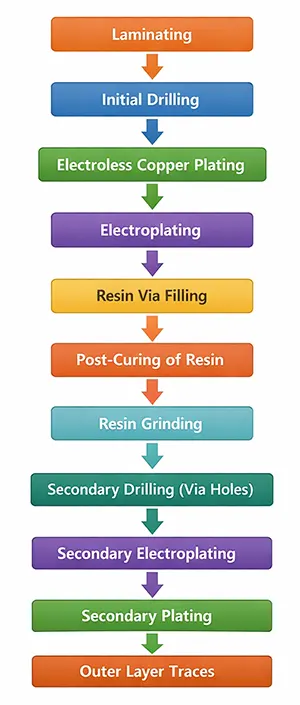
Traditional Process (Selective Resin Filling): Laminating → Drilling → Electroplating → Plating → Dry film application before selective filling (this step is required when hole center-to-center distance ≤ 0.7 mm; otherwise omitted) → Aluminum foil selective filling → Post-filling curing → Post-filling grinding → Secondary electroplating → Secondary plating → Outer layer traces.
New Process Route (Full-Panel Resin Plugging): Laminating → Drilling → Electroless Copper Plating → Electroplating → Applying Protective Film → Laser Window Cutting → Vertical Vacuum Plugging → Post-Curing of Resin → Removing Protective Film → Mechanical Grinding → Secondary Electroless Copper Plating → Secondary Electroplating → Outer Layer Traces.
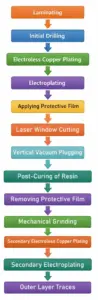
Compared to the traditional route, the core advantage of the new process route lies in the standardization and simplification of the process.
Materials and Equipment
Test Boards: In this study, two representative test boards were designed—a 12-layer conventional board and a 16-layer rigid-flex board—to meet evaluation requirements under different structural and process conditions.
Their specific layer stack-up designs are shown in Figures 1 and 2.
The conventional board adopts a single-unit assembly configuration (one-to-one), with each independent unit (single PCS) containing 59,852 resin-filled vias, through-hole diameters ranging from 0.25 to 0.50 mm, and back-drilled hole diameters ranging from 0.45 to 0.70 mm.
The rigid-flex boards adopt a dual-unit assembly configuration (two-in-one), with each single PCS having 5,488 resin-filled holes, through-hole diameters of 0.25–0.50 mm, and back-drilled hole diameters of 0.45–0.70 mm.


Materials: POFV (Plated on Filled Via) protective film.
Equipment: CO₂ laser, vertical vacuum via-filling machine (Shengfeng VPV-900), metallurgical microscope (Olympus BX53M).
Results and Discussion
Protective Film Application
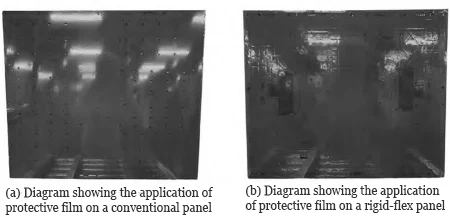
This study validated the suitability of the application process for the POFV protective film (film thickness: 0.06 mm) on the test panels.
Practical application tests confirmed that the protective film adhered smoothly to the panel surface without any defects such as bubbles or wrinkles, demonstrating excellent adhesion (Figure 3).
Precision Laser Window Opening
In the field of PCB laser micromachining, ultraviolet (UV) lasers and carbon dioxide (CO₂) lasers are the two mainstream technologies.
UV laser processing offers high precision but is less efficient and relatively expensive.
In contrast, CO₂ lasers dominate a wider range of industrial applications due to their high power, fast speed, low cost, and system stability.
› Laser Window Dimension Validation
The team led by Tang Longzhou utilized the “heat accumulation effect” of CO₂ lasers to validate a process for the one-step precision ablation (window opening) of 3-μm-thick ultra-thin copper foil covering the target area and the underlying resin layer.
Additionally, Yi Zifeng and colleagues used a laser to directly ablate and cure solder mask ink to form pad windows, effectively resolving the issue of poor ink adhesion caused by chemical side etching in traditional development processes.
The aforementioned studies demonstrate that laser processing technology offers significant advantages—including high precision, absence of lateral erosion, and strong process controllability—in achieving micron-level precision patterning.
Based on this, this study further extends the application of laser processing technology to the selective ablation of POFV protective films.
Figure 4 illustrates the laser aperture stacking design.
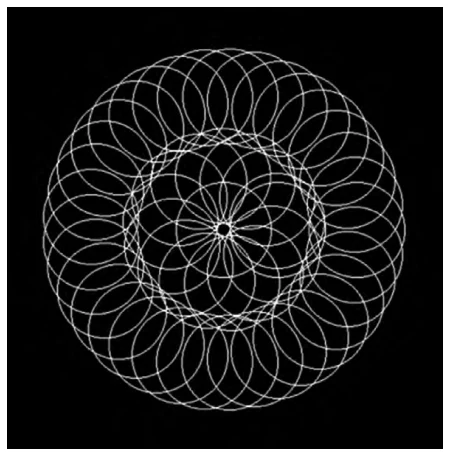
The team used a 0.15 mm laser aperture, achieving a window opening machining accuracy of ±0.01 mm.
Window Dimension Design and Optimization Strategy
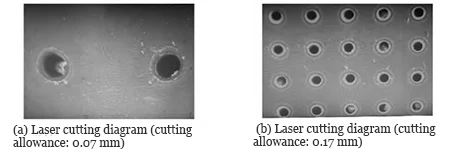
This study conducted two sets of validation tests on laser window dimension design: researchers enlarged the hole diameter by 0.07 mm in one set and by 0.17 mm in the other set, relative to the original design.
The results indicate that when designed with a 0.07 mm allowance (Figure 5a), the reserved space around the window edges is insufficient, which affects the fullness of the plug holes.
Conversely, when using a 0.17 mm offset (Fig. 5b), slight misalignment of the window opening still occurs.
Fluctuations in drilling process capability (Cpk) and laser windowing accuracy cause this misalignment, which in turn affects the filling completeness of the holes.
Therefore, engineers should adjust the offset to enlarge the hole diameter by 0.2 mm compared to the original design.
This adjustment ensures proper filling and alignment tolerance.
This adjustment ensures hole filling quality while providing more ample alignment tolerance.
› Addressing Residual Adhesive Issues
Researchers found that when the laser acts on the copper-free area at the through-hole location, the lack of an effective reflective layer causes excessive energy accumulation.
This accumulation prevents complete vaporization of the protective film and produces residual adhesive at the hole opening (Fig. 5).
Therefore, it is recommended to add a board cleaning step after laser windowing to effectively remove the residual adhesive at the hole opening and ensure windowing quality.
› Improving Laser Processing Efficiency
The currently verified laser windowing efficiency has reached 68,000 holes per minute.
To continuously improve processing efficiency, laser processing time can be further reduced in the following two ways:
(1) Within the limits permitted by the equipment and process, appropriately increase the laser aperture to expand the area processed per pass;
(2) For pre-positioned holes with diameters ≤ 0.35 mm, uniformly process them as 0.35 mm holes to reduce the complexity of laser path planning and processing time.
Vertical Vacuum Via Filling
Manufacturers currently divide resin via filling processes into two main categories: conventional screen printing and vacuum via filling.
The former is low-cost and easy to operate, but it has limited filling density and is prone to bubble formation; it is suitable for consumer electronics products with general reliability requirements.
The latter, however, achieves high-density, low-bubble filling through negative pressure and has become the mainstream process in high-end PCB manufacturing.
Among these, manufacturers most widely use horizontal vacuum via filling.
Vertical vacuum via filling offers exceptional capability for ultra-fine and high aspect ratio vias, and it plays a critical role in high-end packaging substrates and ultra-high-density interconnect (UHDI) boards.
This study employs a vertical vacuum via-filling machine utilizing a “two-fill-one-scrape” process to achieve superior resin filling results.
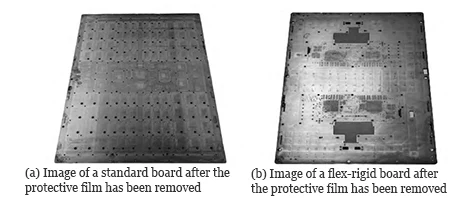
Since the protective film resists high temperatures and peels easily, operators can completely remove it by hand after via-filling and curing, using minimal peeling force.
As shown in Figure 6, the board surface remains clean and residue-free after removal.
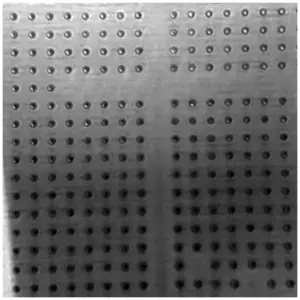
Inspection confirmed that the resin filled the holes with no voids after plugging and baking, as shown in Figure 7.
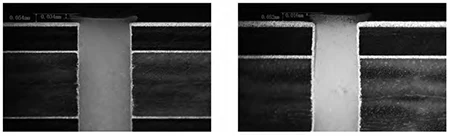
Further cross-sectional analysis of the resin at the hole openings indicated that the initial indentation depth of the resin after baking was 0.016–0.034 mm, which is less than the thickness of the protective film (0.06 mm).
Additionally, the resin filled the hole openings to a height exceeding the copper surface by more than 0.02 mm (Figure 8).
Resin Grinding
Both standard panels and rigid-flex panels require only a single pass through the belt sander to completely remove residual resin, eliminating the need for manual sanding (Fig. 9).
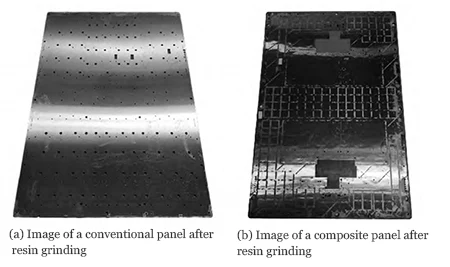
After mechanical grinding, the resin surface at the hole openings is smooth and free of indentations (Fig. 10).
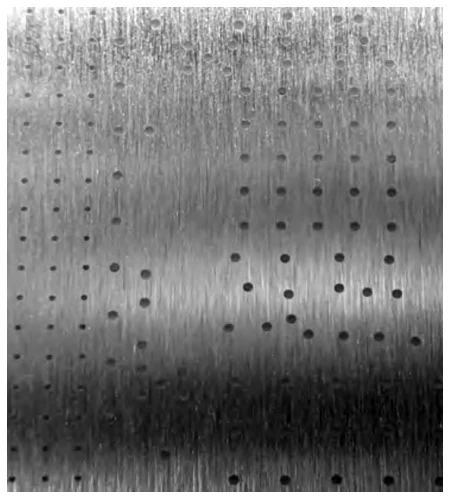
Furthermore, as shown in the cross-sectional images taken after resin polishing, the resin surface at the hole openings is smooth, with resin indentations eliminated.
The process densely fills the interior of the holes with no voids, and the overall quality meets the standard requirements of IPC-6012C-2010 and GJB 362C-2021 (Figure 11).
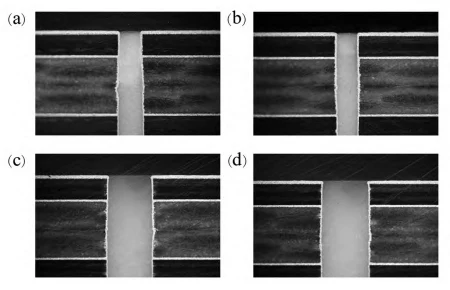
Furthermore, the results of this validation demonstrate that back-drilled holes exhibit consistency with through-holes in terms of resin filling performance; their filling density, hole-mouth flatness, and internal density all meet the same standard requirements.
Conclusion
This study systematically validated the effectiveness of the new “full-board protective film plugging” process in resin plugging for high-density PCBs.
By establishing an integrated workflow comprising “full-board protective film application → precision laser windowing → vertical vacuum plugging → protective film removal → mechanical polishing,” the study successfully addressed the technical bottlenecks inherent in traditional resin plugging processes.
In terms of quality, this process eliminates resin indentations and voids at the hole openings, significantly improving flatness and consistency.
Replacing manual operations with mechanical grinding has automated the process, cutting the production cycle by approximately 50%.
Process optimization has substantially reduced production costs.
This research provides a new technical pathway for ensuring the reliability of high-density PCBs and offers significant guidance for promoting quality improvement and efficiency gains in the printed circuit board manufacturing industry.
This study successfully validated the feasibility of the process. However, researchers need to take further steps to address residual protective film caused by improper energy control during the laser windowing process.
They can optimize parameters such as energy density and spot overlap rate to resolve this issue.
Tests have effectively validated the current process on standard boards and rigid-flex boards.
Future research can extend its application to more complex structures, such as high-layer-count HDI boards, substrate-like boards, and packaging substrates, to further enhance the process’s universality and reliability.