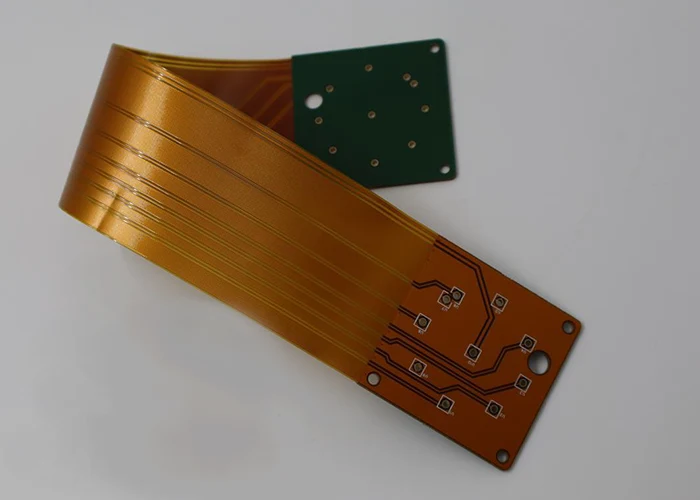
In Benlida’s molding workshop, operator Chen is taking a stack of semi-finished FPC boards out of a storage bin.
As he grabs them, the edges of several boards rub against each other, producing a “squeak.” He pays it no mind and continues working.
A few hours later, during a spot check, the IPQC team from the Quality Department discovered that the surface of this batch of FPCs had numerous fine scratches, some of which had even damaged the circuits.
Out of the entire batch of 200 boards, 60 were scrapped, and the rest had to be downgraded for use.
The shift supervisor asked Chen, “How did these boards get damaged?” Chen looked puzzled: “I don’t know. They were fine when I got them.”
Reviewing the surveillance footage shows that the scratches occurred during two key moments: removal from the storage bin and placement back into it.
The boards were not separated with interleaving paper, so their edges scraped against each other. Excessive handling force bent the boards and created creases.
A protruding foreign object at the bottom of the bin pressed dents into the boards.
FPCs are thin sheets and aren’t as “tough” as rigid boards. They are flexible and lightweight, and cannot withstand scraping, bending, pressure, or impact.
When work-in-progress (WIP) moves between production stages, physical damage caused by poor management can be more common than process defects.
Today, let’s discuss how to properly manage these “delicate” work-in-progress items to prevent them from suffering “secondary damage” during the production process.

Major Types of Damage to FPC Work-in-Progress (WIP) and Their Causes
At Benlida, we have analyzed damage occurring during the WIP stage and identified four main categories:
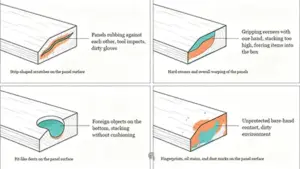
Scratches
Causes: Direct contact between boards, causing friction at sharp edges; burrs on the inner walls of storage bins; operators wearing dirty gloves or causing scratches with their fingernails; impact from tools (tweezers, scrapers).
Creases/Bends
Causes: Gripping a board by one corner with a single hand during handling, causing the board to bend; stacking boards beyond the specified height, causing the bottom boards to be crushed;
Using improperly sized containers, forcing boards into them and causing deformation.
Indentations/Dents
Causes: Foreign objects (debris, oil stains, dry film residue) on the bottom of the container;
Placing heavy objects on top of the boards; stacking multiple boards without separating them with soft padding.
Contamination
Causes: Fingerprints, sweat stains, oil stains, or dust on the board surface, which can affect subsequent lamination or soldering processes.
Some of these defects can be detected immediately (resulting in scrap), while others are hidden and only become apparent during subsequent processes or even after reaching the customer, leading to greater losses.
“Eight-Character Mantra” of WIP Management and Implementation Methods
We have summarized a set of methods to prevent damage to FPC work-in-progress, consisting of eight characters: Separate, Pad, Limit, Smooth, Clean, Inspect, Label, and Train.
Separate — Each Board Must Have Its Own “Individual Space”
FPCs are most vulnerable to direct friction between boards.
Therefore, Benlida mandates that all work-in-progress must use separators (such as sulfur-free paper, bubble wrap, or silicone pads) to isolate each board.
For semi-finished products after lamination but before pressing, use sulfur-free paper as a separator to prevent adhesive bonding and scratches.
After molding, individual FPCs should be stored in trays with dividers, with one board per compartment.
For ultra-thin FPCs (thickness < 0.1 mm), anti-static trays with soft padding must be used.
Padding — Ensure a “Soft Landing” for All Contact Surfaces
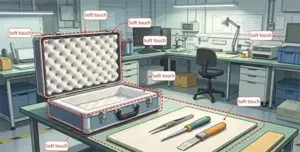
Any surface in contact with FPCs must be free of sharp edges or burrs.
Line the interior walls of transport bins with foam or flannel.
Cover workbenches with anti-static soft mats.
Cover the tips of tools (tweezers, scrapers) with heat-shrink tubing.
When stacking, place a layer of cushioning material at the bottom.
Limits — Limit Quantity and Height
The stacking height per box or per stack must not exceed 20 pieces (or as specified by process requirements).
Exceeding this limit may damage the bottom boards.
The total weight of each storage bin must not exceed 5 kg to prevent bottom deformation during handling.
Mark a “height limit line” in the work-in-progress storage area; stacking above this line is prohibited.
Smoothness — Handle Boards with “Smooth” Motions, Not “Abrupt” Ones
When picking up or placing boards, gently pinch the edges with the thumbs and index fingers of both hands; do not grip the corners with one hand.
When removing boards from a pallet, first lift one corner of the separator sheet, then slowly pull the board out; do not yank it.
Use a dedicated tray or suction pad for board transfer to prevent bending caused by manual handling between operators.
Standard operating procedures must be documented in video format, and new employees must practice by imitating them.
Cleanliness — Keep All Contact Surfaces Clean
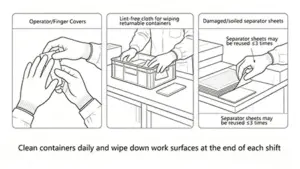
Wipe down returnable containers with a lint-free cloth before the end of each workday to remove debris and oil stains.
Clean work surfaces once per shift.
Reuse separator sheets no more than three times; replace immediately if soiled or damaged.
Operators must wear finger cots or gloves to prevent contamination from fingerprints.
Inspect — Establish a WIP Inspection System
Team leaders must inspect the work-in-progress (WIP) storage area every 2 hours to verify that separator sheets are present, stacks are not exceeding height limits, and containers are not damaged.
IPQC must conduct daily spot checks on the appearance of WIP, using a magnifying glass to inspect for any new scratches.
If batch-wide scratches are discovered, immediately trace the batch through all workstations and transit routes to identify the source.
Label — Clear Labeling to Prevent Mix-ups
Each transport box is labeled with a “batch label” and a “status label” (Pending Inspection/Passed/Failed).
Different FPC models use differently colored separator sheets or trays.
For special products prone to damage (e.g., ultra-thin or fine-line FPCs), affix a “Handle with Care” warning sticker to the transport box.
Train — Train Everyone Who Handles FPCs
This includes not only operators but also material handlers, movers, quality inspectors, and even visitors.
Training content: Why FPCs are susceptible to scratches, proper handling techniques, how to use separator sheets, and examples of violations.
Refresher training is conducted quarterly, and new employees must pass a WIP operation assessment before starting work.
A Successful Improvement Case: WIP Management After Drilling
Benlida’s drilling process used to be a major source of scratches.
After being removed from the drilling machine, the boards were stacked directly into ordinary plastic storage bins without any separator sheets, causing the rough edges to rub against each other.
Each batch resulted in a 1%–2% scrap rate due to scratches.
Improvement Measures:
1. Customized trays: Designed compartmentalized anti-static trays, with one board per compartment and a velvet lining on the bottom.
2. Limited each tray to a maximum of 20 boards; if exceeded, a new tray must be used.
3. Operators wear anti-slip finger cots and use both hands to pick up and place boards; dragging with one hand is strictly prohibited.
4. Install a material collection platform at the drill press exit to automatically feed the boards into the trays, reducing manual handling.
5. Assign a dedicated person per shift to clean and inspect the trays.
6. Results: The post-drilling scratch scrap rate dropped from 1.8% to below 0.1%, resulting in annual cost savings exceeding 100,000 yuan.

Relationship Between WIP Management, 5S, and Lean Production
WIP management is a concrete manifestation of the “Sort” and “Sweep” principles in 5S, and it is also a crucial component of “waste reduction” in lean production.
This is because scrap caused by scratches and creases represents the most direct form of “quality waste.”
A clean, organized, and protected WIP area not only safeguards products but also boosts efficiency—operators don’t have to waste time searching for boards or dealing with rework caused by scratches.
At Benlida, we have incorporated WIP management into our daily 5S checklist and established a rotating “Outstanding WIP Management Team” award.
Common Misconceptions and Corrections
Misconception 1: Only the inspection process requires caution; earlier processes don’t matter.
In fact, scratches can occur at any stage—sharp edges on panels during cutting, burrs after drilling, or brittle panel edges after lamination.
Every process is responsible for protecting work-in-progress.
Misconception 2: It’s okay to reuse release paper.
However, over time, release paper accumulates dust and debris, becoming a new source of contamination. Establish a limit on the number of reuses (e.g., 3 times) and keep records.
Misconception 3: WIP standards can be temporarily ignored when rushing to meet production targets.
This is the most common mistake. The more pressure there is to meet production targets, the more likely rough handling occurs, increasing the risk of scratches.
A culture of “quality over quantity” must be established, and there are no exceptions to WIP standards.
Misconception 4: FPCs are so thin that creases cannot be completely avoided.
Although they are thin, creases can be kept to a minimum as long as handling techniques are correct, pallet designs are reasonable, and stacking heights are controlled.
Benlida’s goal regarding creases is “zero tolerance.”
WIP Self-Check List for Frontline Employees
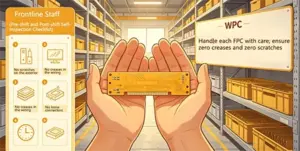
As a frontline employee at Benlida, please take one minute before starting work each day to check the following:
Do I have enough separator sheets and padding at my workstation? Is it clean?
Are there any burrs or foreign objects on the inside walls of the storage bins?
Am I wearing clean finger cots or gloves today?
Do I know the maximum allowed stacking height for this product?
Am I familiar with the correct hand movements for picking up and placing boards in this process?
Before finishing work, please take another minute to check:
Is the separator paper I’m using dirty? Does it need to be replaced?
Are the inside and outside of the storage bins clean?
Are there any boards temporarily placed in unsafe locations (such as table corners or the edges of equipment)?
By developing these habits, scratches and creases will become a thing of the past.
Conclusion: Treat Every FPC with Care
An FPC begins as a roll of copper foil and, after undergoing more than a dozen manufacturing steps, is transformed into a precision circuit.
It is soft and fragile, like a baby. If we throw, stack, pull, or tug at it roughly along the way, it will get hurt and “cry” (becoming a defective product).
At Benlida, we champion a culture of “treating every FPC with care.”
This isn’t because they’re delicate, but because we value the fruits of our labor.
Every FPC embodies the dedication of all preceding processes, and any rough handling at any stage could undo all that hard work.
Your hands are the FPC’s only “caretakers” on the factory floor. Please handle them gently and provide them with a safe “home.”