
Surface-mount technology (SMT) has revolutionized modern electronics manufacturing, making assembly faster, more precise, and highly automated.
Yet, despite its convenience, SMT remains a complex process with many potential pitfalls that can compromise product reliability.
From component placement to soldering, each stage requires careful attention to materials, machine settings, and process parameters.
In this article, we highlight the top five common SMT process defects—from the tombstone effect to BGA soldering issues—and provide practical guidance on how engineers and manufacturers can prevent them.
Understanding these defects is essential for ensuring high-quality assemblies and minimizing costly rework.
Common SMT process defects
Defect 1: The “Tombstone Effect”
The tombstone effect refers to the phenomenon where surface-mount components stand upright.
The primary cause of the “tombstone” phenomenon is an imbalance in the wetting forces at both ends of the component, which creates an imbalance in the torque at both ends, leading to the component standing upright.
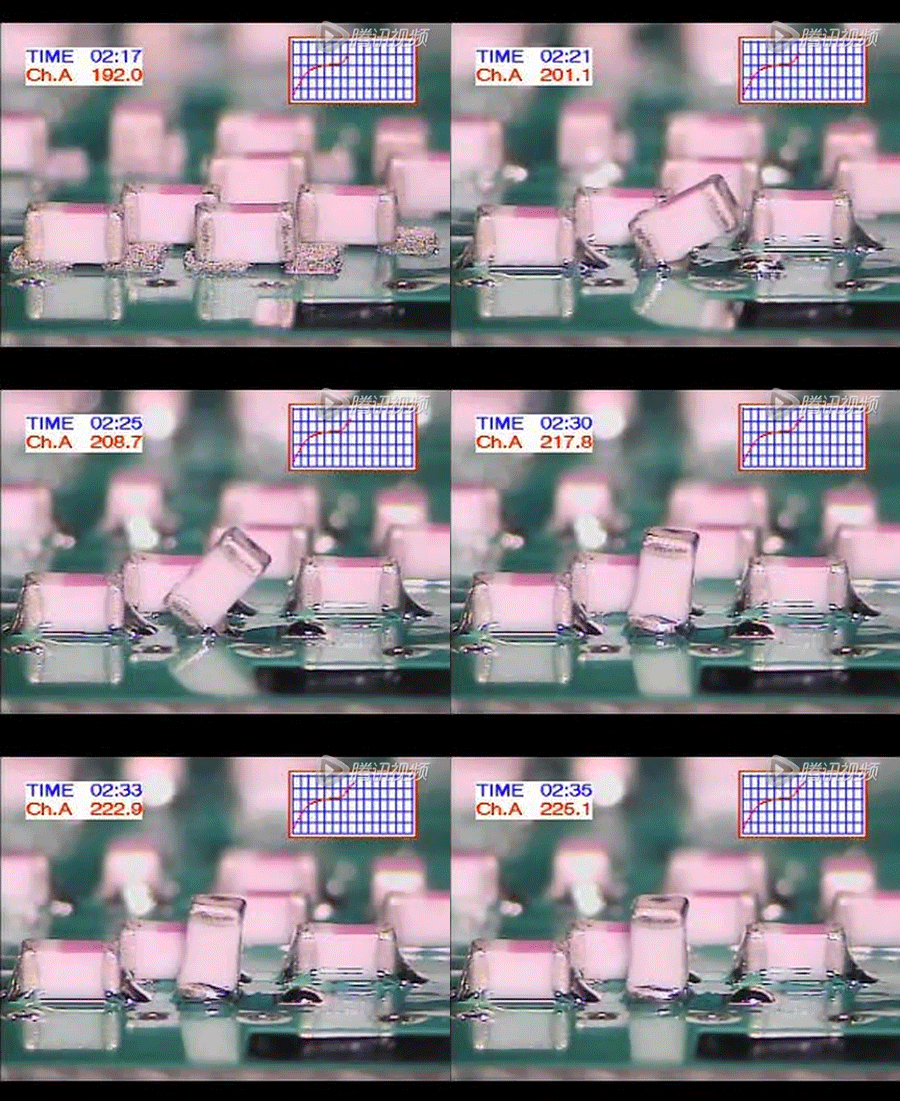
What situations can cause an imbalance in wetting forces at both ends of a component during reflow soldering, leading to the “tombstone” phenomenon?
Factor A: Unreasonable Pad Design and Layout
① One of the pads on either side of the component is connected to ground, or one pad is excessively large, resulting in uneven thermal capacity at both ends of the pad;
② Excessive temperature differences across the PCB surface cause uneven heat absorption on both sides of the component pads;
③ Temperature inconsistencies occur at the ends of small surface-mount component pads located near large devices such as QFPs, BGAs, or heat sinks.
Solution: Engineers should adjust the pad design and layout.
Factor B: Issues with Solder Paste and Solder Paste Printing
① If the solder paste has low activity or the component has poor solderability, the surface tension will vary after the solder paste melts, causing an imbalance in pad wetting force.
② Uneven solder paste deposition on the two pads—with one side having a thicker layer and greater pulling force, and the other a thinner layer with weaker pulling force—causes one end of the component to be pulled toward one side, resulting in a cold solder joint, while the other end is lifted, causing a tombstone effect.
Solution: The factory should select a solder paste with higher activity and optimize printing parameters, particularly the stencil aperture size.
Factor C: Uneven Z-axis forces during component placement
This results in uneven immersion depth of the component into the solder paste.
During melting, the resulting time difference causes an imbalance in wetting forces on both sides. If the component shifts during placement, it will directly lead to tombstoning.
Solution: The factory needs to adjust the placement machine’s process parameters.
Factor D: Incorrect Reflow Oven Temperature Profile
If the reflow oven is too short or has too few temperature zones, it will result in an incorrect heating profile for the PCB, leading to excessive temperature variations across the board surface and causing an imbalance in wetting forces.
Solution: The factory needs to adjust the appropriate temperature profile for each specific product.
Defect 2: Solder Balls
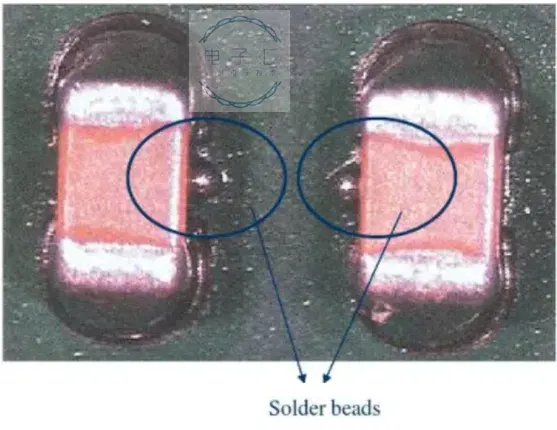
Solder balls are one of the most common defects in reflow soldering; they not only affect appearance but can also cause bridging.
Solder balls can be divided into two categories: one type appears on the side of surface-mount components, often as a single, large, spherical ball (as shown below); the other type appears around IC pins, appearing as scattered small beads.
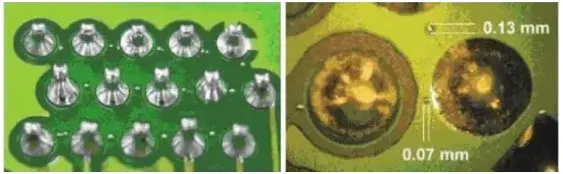
The main causes of solder balls are as follows:
Factor A: Incorrect Temperature Profile
The reflow soldering profile can be divided into four stages: preheating, hold, reflow, and cooling.
The purpose of preheating and holding is to raise the PCB surface temperature to 150°C within 60–90 seconds and maintain it for approximately 90 seconds.
This not only reduces thermal shock to the PCB and components but, more importantly, ensures that the solvents in the solder paste partially evaporate, preventing splattering during reflow caused by excessive solvents, which would otherwise force the solder paste out of the pads and form solder balls.
Solution: The factory must pay attention to the heating rate and implement moderate preheating to ensure sufficient solvent evaporation.
Factor B: Solder Paste Quality
① The metal content in solder paste is typically (90±0.5)%.
If the metal content is too low, the flux content becomes excessive; consequently, the excess flux may not evaporate easily during the preheating stage, leading to solder balls.
② Increased water vapor and oxygen content in the solder paste can also cause solder balls.
Since solder paste is typically refrigerated, if it is not allowed to thaw and reach room temperature and is not stirred thoroughly after removal from the refrigerator, water vapor may enter the paste.
Additionally, the lid of the solder paste container must be tightly sealed after each use; failure to do so promptly can also allow water vapor to enter;
③ After printing solder paste onto a steel mesh stencil, any remaining paste should be disposed of separately.
Returning it to the original container can cause the solder paste inside to deteriorate and lead to solder balls.
Solution: Require the factory to select high-quality solder paste and strictly adhere to storage and usage requirements.
Other factors include:
① Excessively thick printing, causing excess solder paste to overflow when components are pressed down;
② Excessive placement pressure, causing the solder paste to collapse onto the ink;
③ Poor pad opening geometry and lack of anti-balling treatment;
④ Poor solder paste activity, such as drying too quickly or containing too many fine solder particles;
⑤ Printing misalignment, causing some solder paste to adhere to the PCB;
⑥ Excessively fast squeegee speed, leading to edge collapse defects and resulting in solder balls after reflow.
Defect 3: Bridging
Bridging is also a common defect in SMT production. It causes short circuits between components and must be repaired when detected.

The main causes of bridging are:
Factor A: Solder paste quality issues
① Excessively high metal content in the solder paste, particularly when the printing time is too long, which can lead to increased metal content and cause IC pin bridging;
② Low viscosity of the solder paste, causing it to flow beyond the pads after preheating;
③ Poor solder paste tower drop, causing it to flow beyond the pads after preheating.
Solution: The factory needs to adjust the solder paste formulation or switch to high-quality solder paste.
Factor B: Printing System
① Poor repeatability of the screen printer, resulting in misalignment (inaccurate stencil alignment or PCB alignment), which causes solder paste to be printed outside the pads, especially on fine-pitch QFP pads;
② Inaccurate design of stencil aperture dimensions and thickness, as well as uneven Sn-Pb alloy plating on PCB pads, leading to excessive solder paste.
Solution: The factory needs to adjust the printer and improve the PCB pad coating.
Factor C: Excessive placement pressure
Solder paste overflow under pressure is a common cause in production. Additionally, insufficient placement accuracy can cause component shifting and IC lead deformation.
Factor D: Excessively fast heating rate in the reflow oven, preventing solvents in the solder paste from evaporating in time
Solution: The factory needs to adjust the Z-axis height of the placement machine and the heating rate of the reflow oven.
Defect 4: Capillary Effect
The capillary effect, also known as solder wicking or solder pull, is one of the common soldering defects in SMT, frequently observed in vapor phase reflow soldering. Solder detaches from the pad and travels up the lead to the space between the lead and the chip body, resulting in severe cold solder joints.
Causes:
This is typically caused by excessive thermal conductivity of the leads, resulting in rapid heating.
Consequently, the solder wets the leads first, and the wetting force between the solder and the leads is far greater than that between the solder and the pads.
Additionally, upward curvature of the leads further exacerbates the capillary effect.
Solution:
The factory must thoroughly preheat the SMAs (surface-mount assemblies) before placing them in the reflow oven for soldering.
Careful inspection and assurance of the solderability of the PCB pads are essential.
Component coplanarity must not be overlooked; components with poor coplanarity should not be used in production.
Note:
In infrared reflow soldering, the organic flux in the PCB substrate and solder acts as an excellent absorber of infrared radiation, whereas the pins partially reflect infrared radiation.
Consequently, the solder melts first, and the wetting force between the solder and the pad is greater than that between the solder and the pin.
Therefore, the solder does not rise along the pin, significantly reducing the likelihood of capillary action.
Defect 5: BGA Soldering Defects
BGA: Ball Grid Array
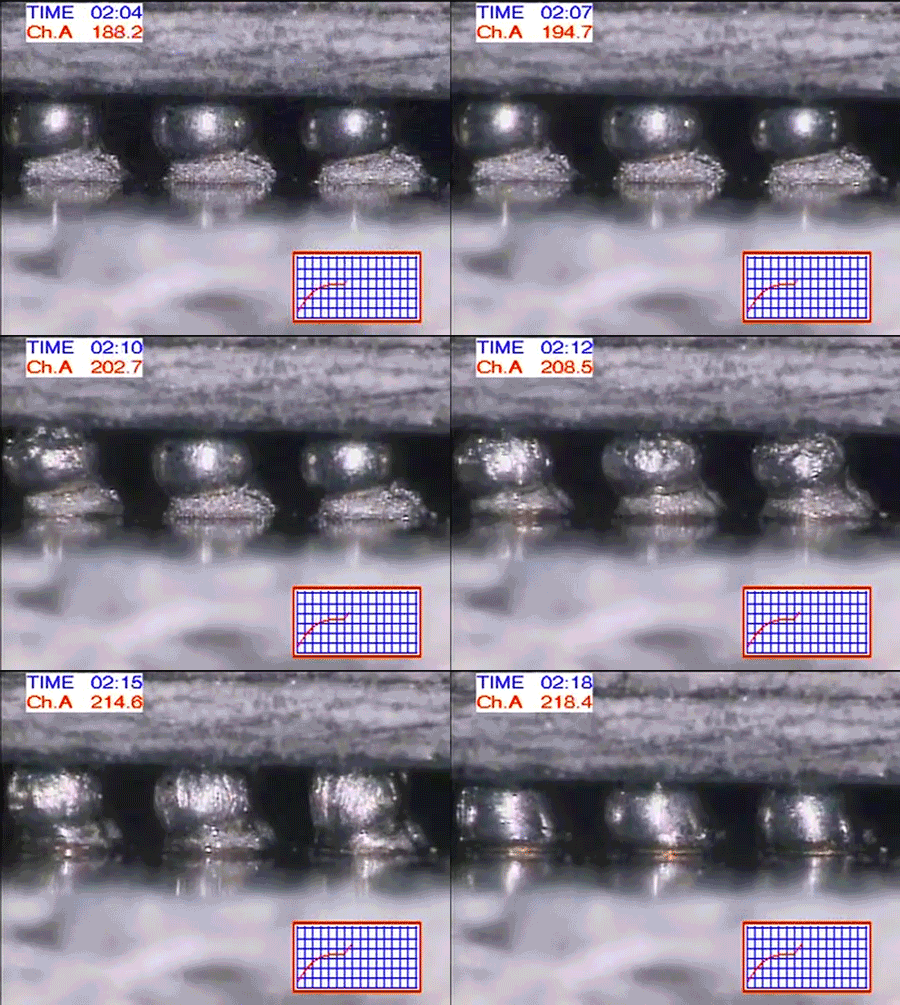
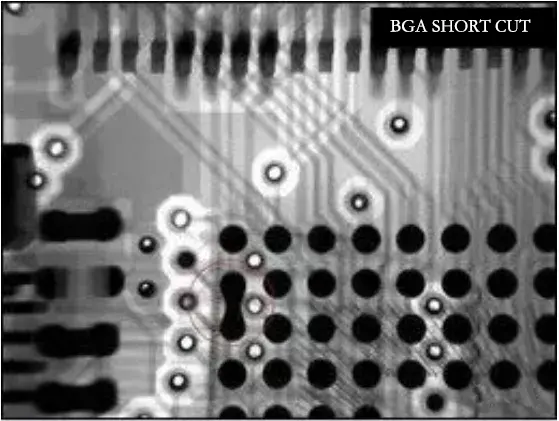
Defect Symptom 1: Solder Bridging
Solder bridging, also known as a short circuit, occurs when solder balls come into contact with each other during the soldering process, causing two pads to connect and resulting in a short circuit.
Solution: The factory should adjust the temperature profile, reduce reflow gas pressure, and improve print quality.
Defect Symptom 2: Cold Solder Joints
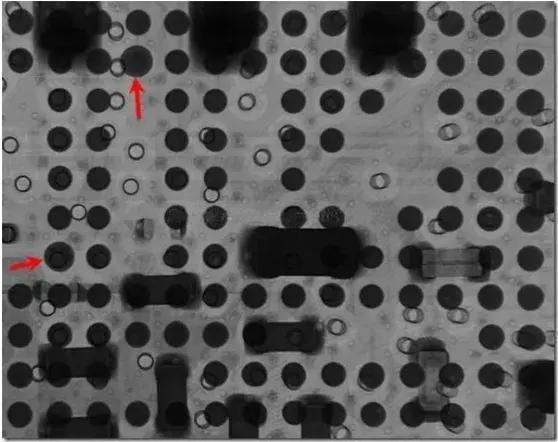
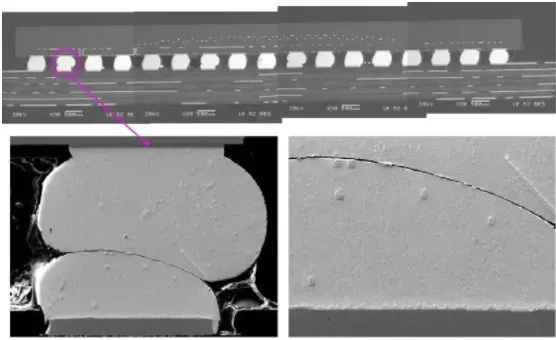
Cold solder joints are also known as the “Head-in-Pillow (HIP) effect.” There are many causes of cold solder joints (oxidation of solder balls or pads, insufficient oven temperature, PCB warping, poor solder paste activity, etc.). A characteristic of BGA cold solder joints is that they are “difficult to detect” and “hard to identify.”

Defect Symptom 3: Cold Solder Joints
Cold solder joints are not entirely synonymous with cold solder joints.
Cold solder joints occur when abnormal reflow temperatures prevent the solder paste from melting completely, which may be caused by temperatures failing to reach the solder paste’s melting point or insufficient dwell time in the reflow zone.
Solution: The factory should adjust the temperature profile and minimize vibration during the cooling process.
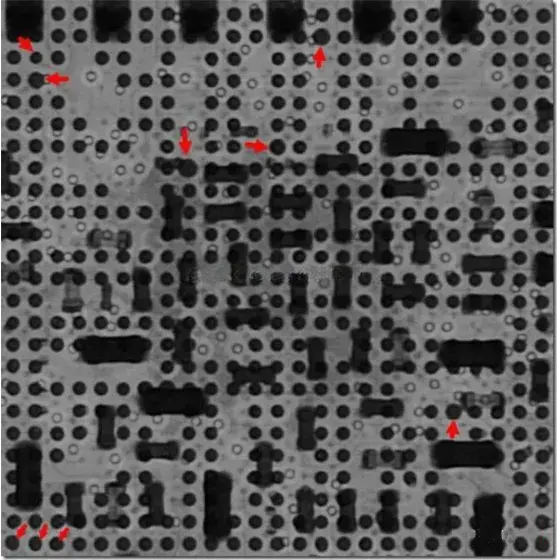
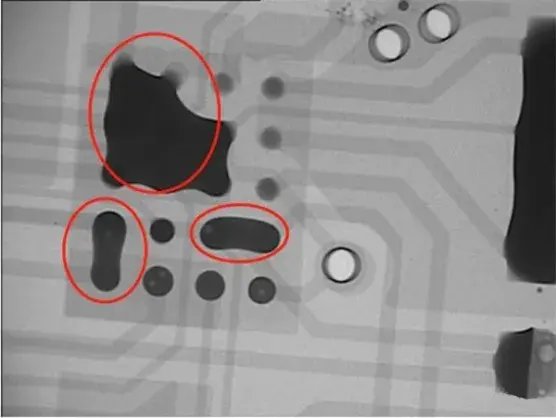
Defect Symptom 4: Air Bubbles
Air bubbles (also known as voids) are not necessarily a defect in themselves, but if they are too large, they can easily lead to quality issues.
There are IPC standards governing the acceptance of air bubbles.
Air bubbles are primarily caused by air trapped inside blind vias that is not properly vented during the soldering process.
Solution: Require the factory to use X-ray inspection to check for voids inside the raw materials and adjust the temperature profile.
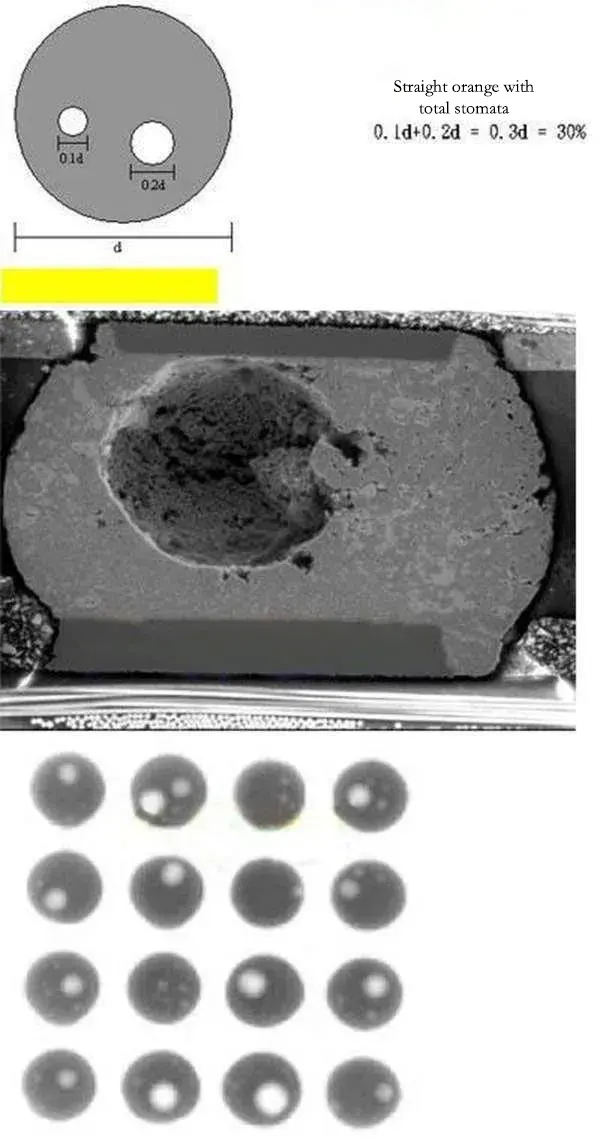
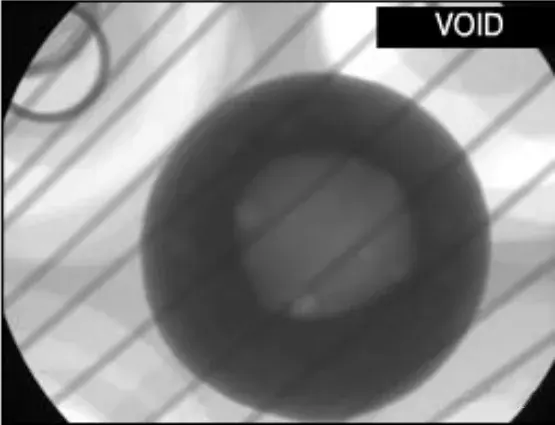
Generally speaking, the size of bubbles should not exceed 20% of the ball’s diameter.
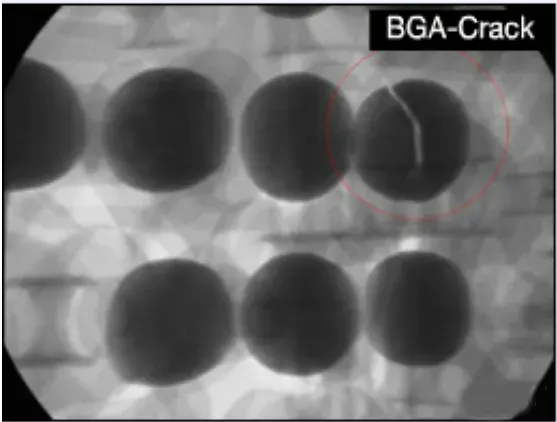
Defect Symptom 5: Solder Ball Cracking
Defect Symptom 6: Contamination
Contaminated pads or residual foreign objects may result from inadequate environmental control during production, leading to foreign matter on the pads or pad contamination that causes soldering defects.
In addition to the above points, there are also:
① Crystallization cracking (the solder joint surface exhibits a glass-like crack pattern);
② Misalignment (the BGA solder joint is misaligned with the PCB pad);
③ Solder splatter (tiny solder balls on the PCB surface near or between two solder joints), etc.
Conclusion
SMT assembly for PCB production is highly efficient, but it requires precise control of multiple factors to ensure reliable solder joint quality.
The five most common defects—tombstoning, solder balls, bridging, capillary effect, and BGA soldering issues—typically result from a combination of improper PCB pad design, inconsistent solder paste quality, inaccurate component placement, and suboptimal reflow profiles.
By optimizing PCB design parameters, maintaining strict process control, and implementing thorough inspection methods, manufacturers can effectively minimize defects, improve product reliability, and achieve consistent assembly quality.
Mastering these critical details not only helps avoid costly rework and failures but also builds a strong foundation for high-performance PCB electronics manufacturing.