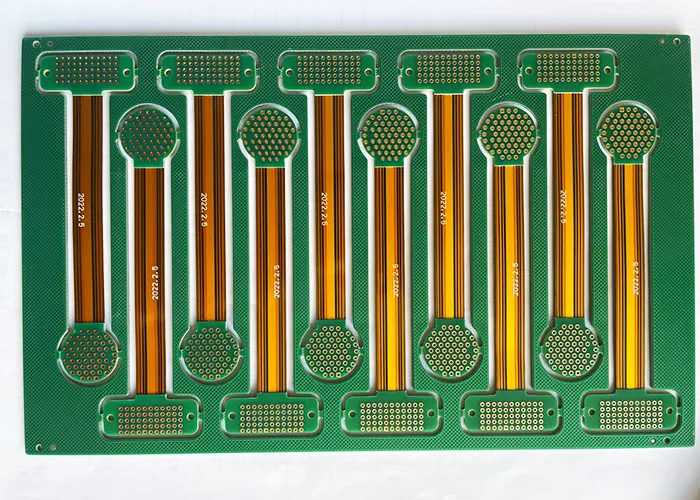
As electronic products continue to evolve toward lighter, thinner, more portable, and more reliable designs, traditional rigid PCBs or flexible FPCs alone can no longer meet the demands of complex applications.
Rigid-flex PCBs combine rigid structural stability with flexible bendability. This combination effectively addresses design challenges across multiple scenarios.
As a result, they have become a preferred choice in fields such as consumer electronics, automotive electronics, and medical devices.
Today, we’ll take a closer look at their core value.
Solving Design Challenges for Mobile Devices
Mobile and portable electronic devices—such as wearables, in-vehicle terminals, and portable medical instruments—face more rigorous challenges than fixed devices:
Designers must ensure these devices follow ergonomic principles while also withstanding complex environmental factors.
These factors include physical impacts, temperature fluctuations, humidity changes, and solar radiation.
These challenges increase the performance requirements for PCBs, especially in terms of stability, reliability, durability, and flexibility.
Traditional rigid boards cannot bend to fit irregular shapes, while single-layer flexible boards fail to provide sufficient structural support.
Rigid-flex boards combine rigid areas for component mounting with flexible areas for connections and bending through an integrated design.
This structure enables them to effectively solve these challenges and positions them as an ideal solution.
Key Advantages: Lightweight, Highly Reliable, Easy to Assemble
Ultra-lightweight Design Reduces Product Weight
The material used in the flexible areas of rigid-flex boards weighs only about 10% of that used in rigid boards of the same size.
The integrated design reduces the number of required connectors.
As a result, it lowers overall product weight while also minimizing the space occupied by connectors.
This makes it particularly well-suited for weight- and space-sensitive products such as smartphones, smartwatches, and hearing aids.
Take hearing aids as an example: their internal space is extremely limited, and they must conform to the contours of the ear canal.
Rigid-flex PCBs enable stable connections while achieving weight reduction, ensuring functionality while enhancing wearing comfort.
Doubled Reliability, Reduced Risk of Failure
Traditional PCBs rely on connectors to interconnect modules.
After prolonged use or exposure to vibration and thermal shock, issues such as loose connectors and poor contact are common.
The integrated structure of rigid-flex PCBs reduces the number of interconnection points at the source:
- Prevents failures caused by loose connectors, enhancing long-term product stability;
- Reduces human error during assembly, lowering defect rates in production;
- The flexible areas absorb vibration and shock, making them suitable for high-vibration environments such as automotive and portable devices.
Improved Assembly Efficiency and Adaptability to Complex Spaces
Rigid-flex boards bend and fold easily, allowing them to adapt to complex curves and confined spaces within products.
This capability resolves key limitations of traditional rigid boards, including poor conformability and inefficient space utilization.
Reduced connector count simplifies the assembly process, shortens production cycles, and lowers assembly costs.
This improves efficiency and makes the approach especially suitable for mass-produced consumer electronics and automotive electronics.
Signal Integrity and EMC: The “Guardians” of High-Speed Data Transmission
High-speed data transmission applications place strict demands on design, especially in industrial cameras, video cameras, and high-end smartphones.
These systems prioritize signal quality and electromagnetic compatibility (EMC) as core design requirements.
In such scenarios, mixed-signal PCBs demonstrate significant advantages:
Optimized Signal Integrity
A large volume of high-frequency data must be transmitted between the image sensor and the ISP (Image Signal Processor).
In traditional solutions, signals passing through connectors are prone to sudden impedance changes and signal attenuation.
The integrated transmission path of rigid-flex PCBs eliminates the need for connectors, making it easier to maintain impedance continuity.
This effectively reduces signal reflections and crosstalk, ensuring the stability of high-speed data transmission.
Enhanced Electromagnetic Compatibility (EMC)
Rigid-flex PCBs allow for the design of complete shielding structures in the flexible regions, avoiding the poor shielding contact issues commonly associated with cable connections.
This design reduces electromagnetic interference (EMI) radiation and minimizes the impact of external radio frequency (RF) interference on internal signals.
As a result, it enables products to meet stringent EMC industry standards in sectors such as automotive electronics and medical devices.
Resilience in Extreme Environments: A New Level of Reliability
In extreme environments characterized by drastic temperature fluctuations, frequent vibrations, and chemical corrosion, rigid-flex boards offer far greater resilience than traditional solutions:
Strong Resistance to Environmental Shocks
Whether a vehicle is traveling through the extreme heat of Turpan or the bitter cold of Heihe, thermal shock causes materials to expand and contract.
Traditional connectors are prone to loosening and failure under these conditions.
The integrated structure of rigid-flex boards eliminates the risk of loosening; the flexible sections cushion stress from thermal expansion and contraction.
Additionally, they offer excellent resistance to chemical corrosion and UV radiation, making them suitable for complex operating conditions such as in-vehicle and outdoor equipment.
Superior Heat Dissipation Performance
Compared to connector-based solutions, rigid-flex boards can directly increase the surface area of the copper layers, thereby expanding the heat-dissipation area and reducing thermal resistance.
This allows heat generated during device operation to dissipate rapidly, preventing component aging or performance degradation caused by high temperatures.
They are particularly suitable for high-power-density products such as automotive LiDAR and industrial control modules.
Diverse Application Scenarios: Addressing Core Needs Across Multiple Industries
The advantages of rigid-flex boards enable their widespread application across multiple fields:
- Consumer electronics: foldable smartphones, smartphone cameras, and tablet touchscreen modules;
- Wearable devices: smartwatches, fitness trackers, and smart glasses, designed to meet ergonomic and lightweight requirements;
- Automotive Electronics: LiDAR, navigation systems, and instrument panels, designed to withstand vibration and temperature fluctuations;
- Medical Devices: Hearing aids, portable monitors, and minimally invasive surgical instruments, meeting requirements for precision and portability;
- Aerospace: Satellite communication modules and aircraft navigation systems, designed to withstand harsh environments and meet lightweight requirements.
Summary
Rigid-flex boards combine rigidity and flexibility to solve key limitations of traditional rigid boards, including their inability to bend and inefficient space utilization.
They also eliminate weaknesses found in purely flexible boards, such as insufficient structural stability and weak mechanical support.
As a result, they deliver comprehensive improvements in weight reduction, reliability, signal integrity, and environmental adaptability.
Consumer electronics increasingly adopt slim and lightweight designs, while automotive electronics adapt rigid-flex boards to withstand extreme environments.
Medical devices rely on them for precise signal transmission, and across all these fields, rigid-flex boards actively drive product innovation as a core enabling component.