
The performance and reliability of electronic equipment are closely related to the environment.
In the operating environments of modern electronic devices, corrosion caused by humidity, salt fog, and mold is quite common and can cause significant damage to electronic products.
To protect electronic products from such damage, a layer of triple-proof varnish is sprayed or brushed onto the surface of circuit boards.
During storage or operation, the triple-proof varnish coating acts as a barrier against harsh environments, protecting against moisture, mold, and salt fog corrosion.
It also prevents sudden temperature changes from which can cause a drop in insulation resistance between printed conductors or even short circuits.
For printed circuit boards operating at higher voltages or in low-pressure environments, coating them with this varnish can effectively prevent corona discharge, creepage, and breakdown between conductors, thereby enhancing product reliability.
Traditional methods for applying conformal coatings primarily involve brushing and manual spraying.
Disadvantages include:
- Difficulty in controlling coating thickness and poor consistency, which affect product quality;
- High labor intensity, low efficiency, and susceptibility to operational errors;
- Serious hazards to the environment and operators.
The QJ 3259-2005 standard, “Technical Requirements for Protective Coating of Aerospace Electronic Products,” stipulates that the thickness of the conformal coating film should generally be 30–50 μm.
Polyurethane varnish, commonly used in the aerospace sector, serves as the coating material in this study.
The research examines an automated coating system and its key process parameters.
These parameters are analyzed in relation to their influence on the thickness of the conformal coating film.
The work targets the formation of a coating film that satisfies thickness requirements. It also targets the formation of a coating film with good adhesion performance.
Testing
Test Equipment and Materials
The test utilized automatic triple-proof coating equipment and an electronic balance (accuracy: 0.1 g).
The triple-proof coating mixture consisted of polyurethane varnish and polyurethane curing agent in a 6:1 ratio.
Depending on the ambient temperature, an appropriate amount of thinner was added to maintain a viscosity of 16–20 seconds.
Coating Process Flow
Pre-coating inspection → Pre-coating cleaning/surface preparation → Pre-baking and dehumidification → Varnish preparation → Varnish application → Drying → Inspection → Packaging.
Test Protocol
We employ a single-factor experimental design.
While keeping all other conditions constant, we investigate the effects of the discharge control valve setting, spray height, mass fractions of the diluent and conformal coating, and spray speed on the average thickness of the conformal coating film individually.
We then determine the process parameters that satisfy the required film thickness.
Under these process conditions, we prepare coated specimens, section them, and use a scanning electron microscope to verify the film thickness.
Thickness Measurement
After the automatic coating equipment applies the conformal coating to the test specimens, operators select five areas on each specimen for sectioning in accordance with the requirements of 8.3.2 in GB/T 4677-2002.
Operators then measure the thickness of the sections using a scanning electron microscope.
Results and Discussion
Effect of Flow Rate on the Thickness of the Triple-Protection Coating
A rotary control valve controls the nozzle outlet size of the triple-protection coating system, and adjusting the outlet diameter regulates the flow rate.
With a spray height of 5 cm, a mass ratio of 1:4 between the diluent and the triple-protection coating, and a spray speed of 120 mm/s, this study investigates how the flow rate affects coating thickness.
Table 1 shows the average film thickness corresponding to different settings of the flow control valve.
It can be seen that the flow rate has a direct impact on film thickness: a higher flow rate results in a thicker film, while a lower flow rate results in a thinner film.
Under constant conditions, the appropriate setting for the flow control valve to meet film thickness requirements is 4.5–5.5.
| Discharge Control Valve Scale | Average Coating Thickness / μm |
|---|---|
| 4.0 | 25 |
| 4.5 | 30 |
| 5.0 | 38 |
| 5.5 | 45 |
| 6.0 | 55 |
Table 1. Effect of Discharge Volume on Average Coating
The Effect of Spray Height on the Thickness of the Conformal Coating Film
Spray height refers to the vertical distance between the nozzle and the circuit board; it is a critical parameter.
This study investigates the effect of spray height on film thickness. Set the flow control valve to 5.0.
Use a mass ratio of 1:4 between the diluent and the conformal coating. Maintain a spray speed of 120 mm/s.
Table 2 shows the average coating thickness corresponding to different spray heights.
It can be seen that spray height has a significant effect on coating thickness, with the two being inversely proportional.
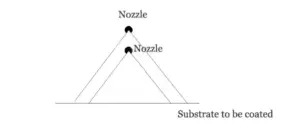
This is because the farther the nozzle is from the substrate, the wider the contact area between the sprayed coating and the substrate, resulting in a thinner coating.
Figure 1 illustrates the effect of nozzle height on the coating width.
When all other conditions remain constant, a greater nozzle height results in a wider contact width between the paint and the substrate, leading to a thinner paint film.
Under these conditions, the optimal spray height to meet paint film thickness requirements is 2–3 cm.
| Spray Height h / cm | Average Coating Thickness / μm |
|---|---|
| 2.0 | 42 |
| 2.5 | 38 |
| 3.0 | 33 |
| 3.5 | 27 |
| 4.0 | 25 |
Table 2. Effect of Spray Height on Average Coating Thickness
The Effect of the Mass Fraction of Thinner and Conformal Coating on Film Thickness
The mass fraction of the thinner and conformal coating affects the viscosity of the coating.
A higher mass fraction results in higher viscosity, making application difficult and increasing the likelihood of quality issues such as uneven thickness.
A lower mass fraction results in lower viscosity, which affects the film thickness.
With the flow control valve set to 5.0, a spray height of 2 cm, and a spray speed of 120 mm/s, the effect of the mass fractions of the thinner and the conformal coating on the film thickness was investigated.
Table 3 shows the corresponding film thicknesses for different mass fractions.
It can be observed that the mass fraction of the solvent and the conformal coating is inversely proportional to the thickness of the conformal coating film.
This is because the higher the content of solvent in the coating sprayed onto the substrate, the smaller the amount of conformal coating available to form the film after the solvent evaporates, resulting in a thinner conformal coating film.
Under constant conditions, to meet the required film thickness, the appropriate mass ratio of thinner to conformal coating is 1:3 to 1:4.
| Mass Fraction | Average Coating Thickness / μm |
|---|---|
| 1:2 | 52 |
| 1:3 | 45 |
| 1:4 | 39 |
| 1:5 | 27 |
Table 3. Effect of Mass Fraction on Average Coating Thickness
The Effect of Spray Speed on the Thickness of the Triple-Protection Coating
Spray speed refers to the amount of material dispensed per unit of time and also affects the thickness of the coating.
By maintaining the flow control valve setting at 5.0, a spray height of 2 cm, and a mass ratio of 1:4 between the thinner and the triple-protection coating, we investigated the effect of spray speed on coating thickness.
Table 4 shows the coating thicknesses corresponding to different spray speeds. It can be observed that spray speed is inversely proportional to coating thickness.
This is because the faster the spray speed, the less coating material applied per unit area, resulting in a thinner coating.
Under constant conditions, the appropriate spray speed to meet coating thickness requirements is 100–160 mm/s.
| Spray Coating Speed (mm·s⁻¹) | Average Coating Thickness (μm) |
|---|---|
| 100 | 49 |
| 120 | 43 |
| 160 | 38 |
| 200 | 25 |
Table 4: Effect of Spray Coating Speed on the Average Coating Thickness
Test Validation
Thickness Validation
The single-factor experiment identified the required process conditions for achieving the target coating thickness. Set the discharge control valve to 5.0.
Maintain a spray height of 2 cm. Use a mass ratio of 1:4 between the diluent and the conformal coating. Set the spray speed to 120 mm/s.
The process prepared test specimens with conformal coating according to these parameters.
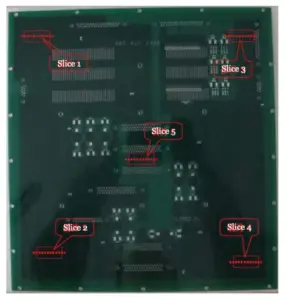
The test cut five sections from the specimens, as shown in Figure 2.
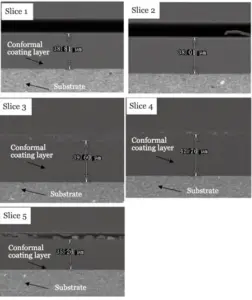
The scanning electron microscope (SEM) measured the thickness of the conformal coating film on the cross-sections.
Figure 3 presents the cross-sectional images at different locations, and Table 5 lists the thickness values of each section.
The measured thickness ranged from 30 to 50 μm and satisfied the requirements of aerospace standard QJ 3259-2005.
| Insert Number | Coating Thickness (μm) |
|---|---|
| Insert 1 | 38.81 |
| Insert 2 | 38.01 |
| Insert 3 | 39.60 |
| Insert 4 | 42.76 |
| Insert 5 | 35.26 |
Table 5: Coating Thickness of Different Inserts
Visual Inspection
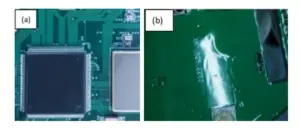
Figure 4 shows a comparison of the appearance of conformal coating films applied using automated coating versus traditional manual brushing.
Fig 4(a) illustrates the automated coating process, while Figure 4(b) shows the manual brushing process.
The figure illustrates that the automated coating process yields a uniform film with consistent properties.
In contrast, the manual brushing process causes buildup, uneven thickness, and poor consistency.
Conclusions
1) The flow rate, spray height, mass ratio of thinner to conformal coating, and spray speed significantly affect the coating thickness. These process parameters directly influence the final film thickness.
The flow rate is directly proportional to the thickness of the conformal coating film, while the spray height, mass ratio of thinner to conformal coating, and spray speed are inversely proportional to it.
2) When using polyurethane varnish, set the flow control valve to 5.0 and maintain a spray height of 2 cm.
Use a mass ratio of 1:4 between the thinner and the conformal coating, and set the spray speed to 120 mm/s.
These process parameters produce a conformal coating film with a thickness of 30–50 μm and satisfy the requirements of the QJ 3259-2005 standard.
3) When using automatic conformal coating technology, the coating film is uniform and consistent; manual application, however, is prone to defects such as buildup, difficulty in controlling thickness, and poor uniformity.